Renting the Ruler: How Benchmark Rights Are Billed to Fund Shareholders
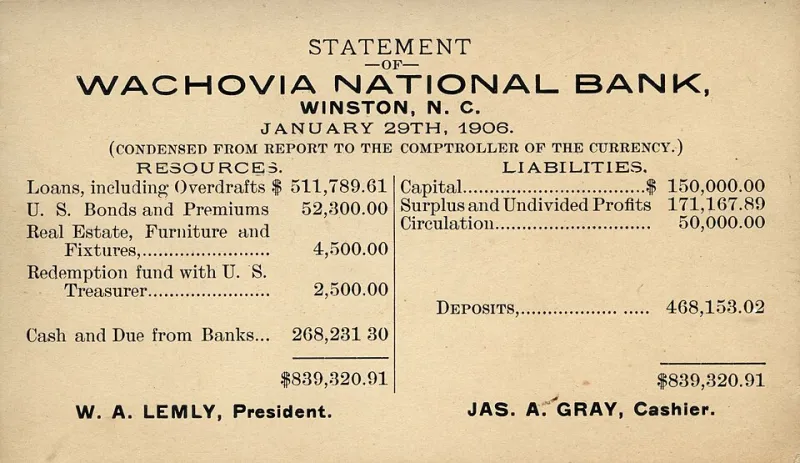
Photo: Wachovia National Bank, Winston, NC, Public domain, via Wikimedia Commons
A fund’s benchmark appears in marketing material as a neutral reference point: a ruler against which performance is measured. In practice, that ruler is frequently rented. Index providers construct methodologies, maintain constituent lists, calculate returns, license trademarks, and supply data under contracts with fund advisers or the funds themselves. The cost of those rights can sit inside the expense ratio, inside the advisory fee, or inside a footnote that explains why one line item moved. For long-term shareholders, the important question is not whether the benchmark has a price. It is who pays that price, how it scales, and what happens when the license terms change.
Where the licensing cost lives in the paperwork
Index licensing fees rarely announce themselves on the cover of a prospectus. They are more likely to appear in the fund’s financial statements, particularly the Statement of Operations, where expenses are broken out by category. A line labeled “index fees,” “license fees,” or “benchmark fees” is the clearest signal. In other cases, the cost is folded into “other expenses,” “professional fees,” or a broader “administration” category. The prospectus fee table may show only the aggregate expense ratio, while the notes and the Statement of Additional Information supply the contractual detail.
That detail matters because a fund’s expense ratio is an accounting summary, not a contract. Two funds with the same headline expense ratio can allocate costs very differently. One may pay the index provider directly from fund assets; another may have the adviser absorb the license fee as part of its advisory responsibilities. The shareholder’s economic exposure can be similar, but the governance and disclosure trail differs. When the adviser pays, the license cost is a business expense that shapes the adviser’s incentives and may influence future fee negotiations. When the fund pays, the cost is visible as a fund expense and flows directly through the expense ratio.
Two fund structures, one economic question
Exchange-traded funds and index mutual funds often approach licensing from different starting points. Many ETFs operate under a unitary fee arrangement, in which the adviser agrees to pay specified fund expenses—sometimes including index licensing—out of a single advisory fee. The appeal is simplicity: the fund’s expense ratio is meant to be a ceiling, and the adviser bears the risk of cost overruns. But simplicity is not the same as invisibility. If licensing costs rise, the adviser must absorb them, negotiate a lower fee, or adjust the fund’s economics in some other way. Shareholders should read the advisory agreement and the fee table notes to understand which costs are inside the unitary fee and which are outside it.
Index mutual funds more often pass licensing costs through to the fund, especially when the fund is part of a larger complex with multiple share classes. The expense table may show a single “other expenses” figure, but the financial statements can reveal a discrete license line. Neither model is inherently better. The question is whether the arrangement is disclosed clearly enough for a shareholder to understand what is being purchased. A benchmark license is not a trading cost or a one-time filing expense; it is a recurring payment for the right to use a name, a methodology, and a data set. That payment should be legible in the fund’s cost profile.
The benchmark as a product with terms
An index license is a contract with boundaries. It may specify the index provider’s trademark rights, the permitted use of the index name, the frequency and format of constituent data, the treatment of corporate actions, and the consequences of a methodology change. It may also set the fee as a percentage of fund assets, a flat annual amount, or a tiered schedule. Those terms can affect the fund long after the initial launch.
Consider a fund that tracks an index owned by a large data provider. The provider may revise the index methodology, change the rebalancing calendar, or alter the eligibility rules for constituents. The fund’s board and adviser must decide whether the fund can continue to track the revised index or whether a benchmark change is warranted. Each path has costs: transaction costs from reconstitution, potential tax consequences, and the administrative expense of amending the prospectus and shareholder communications. The license itself may also contain termination provisions that trigger a rename or a transition period. For a long-term holder, these are stewardship events, not merely marketing updates.
Reading the signals as a long-term owner
A practical review begins with the fund’s most recent annual report and Statement of Additional Information. Look for a line item for index or license fees, then compare it with prior years. A fee that grows faster than assets may reflect a renegotiated contract, a new index, or a change in the provider’s pricing schedule. If the expense is buried in “other expenses,” read the notes for a breakdown. If the adviser pays the license under a unitary fee, check whether the arrangement is described in the advisory agreement and whether any recoupment or waiver provisions apply.
Second, compare the fund’s benchmark to the license disclosure. Is the index proprietary? Does the provider also sell investment products that compete with the fund? Does the fund’s board disclose any conflicts when approving the advisory contract? These questions do not imply wrongdoing. They simply recognize that a benchmark is an economic relationship, and relationships have terms.
Third, watch for benchmark changes. A new index can be a legitimate response to a flawed methodology, but it can also reset a track record in ways that complicate performance evaluation. The fund’s shareholder reports should explain the rationale, the transition costs, and whether the license fee changed. A quiet rename is not enough.
A cost that deserves a line of its own
Index licensing is not a scandal hiding in every fund. It is a normal cost of running an indexed product, and many funds disclose it adequately. But normal costs can still be poorly understood. When a fund’s identity depends on a benchmark name, shareholders are paying for more than data; they are paying for the credibility, methodology, and trademark that make the product recognizable. That is a legitimate purchase, provided the price is disclosed and governed.
The next time a fund fact sheet presents a benchmark as a neutral reference, read the financial statements for the contract behind it. The ruler may be rented, but the bill should not be a mystery.